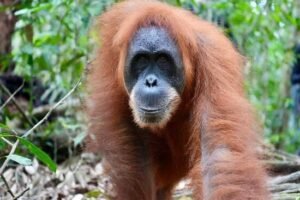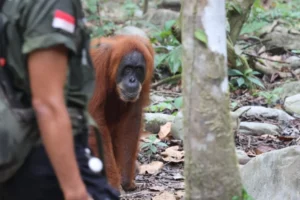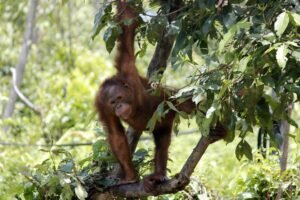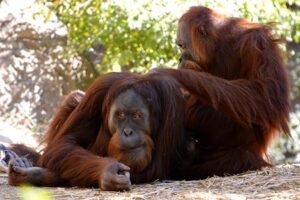
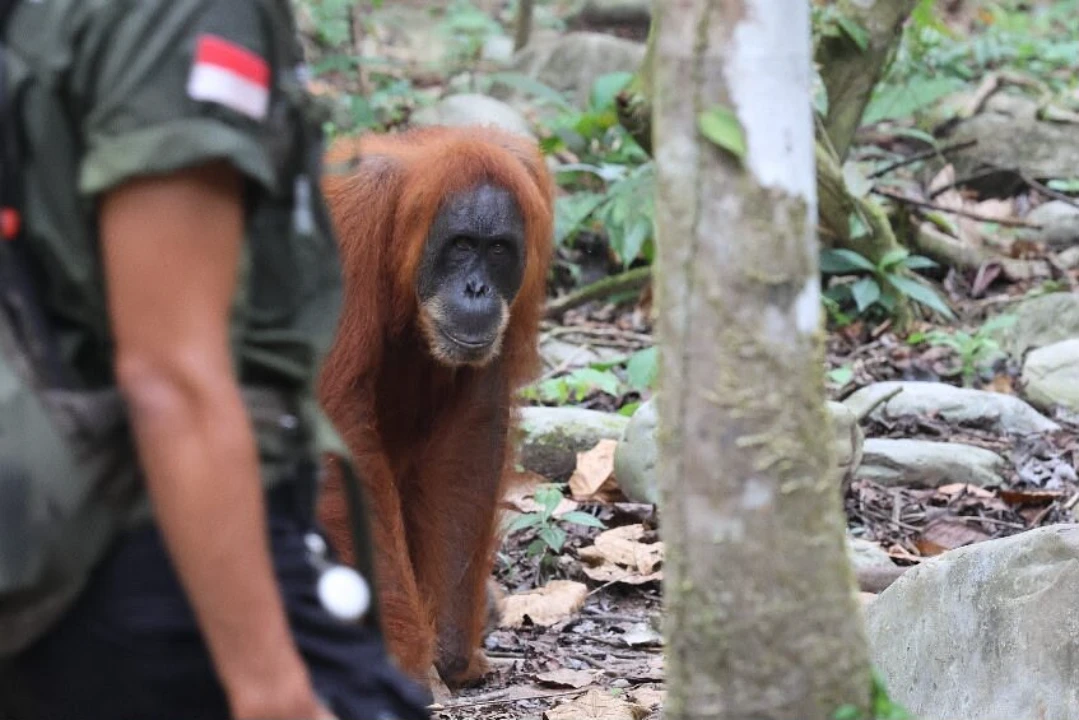
During an orangutan trek, you may see an orangutan feeding, resting, moving through the canopy, building a nest, or caring for an infant.
You may also see nothing more than moving branches or orange hair behind the leaves.
Both are normal wildlife experiences.
Orangutans do not follow a visitor schedule. Their behaviour depends on the individual, available food, weather, other animals, and what is happening around them.
Understanding a few basic behaviours can help you appreciate an encounter without disturbing it.
Orangutan Behavior Is Not a Performance
An orangutan may stay in one tree for a long time. It may turn away, move higher into the canopy, or leave before you can take a clear photograph.
This does not mean the encounter has failed.
The rainforest is the animal’s habitat. The orangutan is feeding, resting, travelling, or making decisions based on its own needs.
A respectful encounter allows the animal to continue its natural behaviour. It should not be called, fed, followed, or moved into a better position for visitors.
Read more about ethical orangutan trekking before entering the forest.
Every Orangutan Is Different
Age, sex, individual history, food availability, and the presence of other orangutans can all affect behaviour.
One orangutan may remain calm in the canopy while another moves away quickly. An infant may explore nearby branches while staying close to its mother. A male may be heard without ever becoming visible.
Avoid giving an orangutan a human personality based on a short encounter.
An animal that appears relaxed is not necessarily inviting people to approach. An animal looking toward a camera is not posing for it.
A Close Sighting Is Not Always a Better Sighting
The quality of an encounter should not be measured by distance.
An orangutan feeding high above the trail is using the rainforest naturally. Leaves may block part of the view, but that is often what responsible wildlife observation looks like.
Use binoculars or camera zoom when appropriate. Do not move closer or remove vegetation to improve a photograph.
Orangutans Are Solitary but Still Social
Orangutans are more solitary than many other great apes, but this does not mean they have no social relationships.
Research describes Sumatran orangutans as living within loose communities. Their home ranges can overlap, and some individuals associate with particular neighbours. You can read the research on Sumatran orangutan social organisation for more detail.
Adult males are often alone. Adult females are commonly accompanied by dependent offspring.
Why Orangutans Often Travel Alone
Food is spread across the rainforest. A tree may provide fruit for a limited period before the orangutan needs to move elsewhere.
Travelling alone can reduce competition for food. A mother normally travels with her dependent offspring, but permanent groups are not typical.
This is why a trek may involve searching quietly for one orangutan rather than finding a large group.
When Orangutans May Be Seen Together
Several orangutans may feed near one another when food is abundant.
This does not necessarily mean they form a permanent group. They may share an area or feeding opportunity and later continue in different directions.
Visitors should maintain the required distance even when several animals appear relaxed. More orangutans in one area can also make their movement more difficult to predict.
A Typical Day Can Look Very Quiet
A large part of an orangutan’s day involves searching for food, eating, moving between trees, and resting.
The SOCP guide to Sumatran orangutan behaviour provides detailed information about these daily activities.
Feeding in the Canopy
Fruit is an important part of the Sumatran orangutan diet. Orangutans may also eat leaves, stems, bark, insects, and other naturally available foods.
Their diet changes with food availability. An orangutan may remain in a productive tree for a long time, selecting and eating food carefully.
What appears to be inactivity may be a normal feeding session.
Never offer fruit, snacks, or leftovers. Human feeding can change how an orangutan behaves around visitors.
Moving Through the Trees
Sumatran orangutans spend most of their lives in trees.
They use their hands and feet to hold branches and move through the canopy. They may shift their weight carefully, bend smaller trees, or use connected branches to reach another area.
Movement can look slow and deliberate. This helps the animal navigate the canopy while conserving energy.
Leaves and branches may hide much of this activity from people standing below. Wait where your guide positions the group instead of trying to follow the orangutan off the trail.
Resting Is Normal
An orangutan may stop moving and rest for a long period.
Resting does not automatically mean that the animal is sick, bored, or waiting for something. Moving through the canopy and finding food require energy.
Let the animal decide when to move again. Do not make sounds or open food in an attempt to attract its attention.
Why Orangutans Build Nests
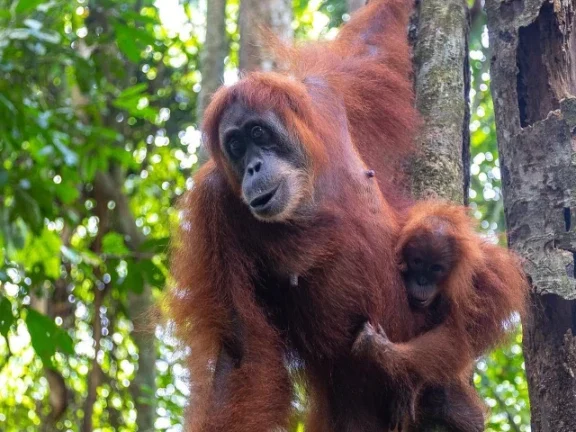
Orangutans build leafy nests in trees for sleeping and resting.
They create a supporting structure from branches and add smaller branches and leaves. A fresh nest can look like a large bowl of folded vegetation in the canopy.
Orangutans often build a new sleeping nest, although an old nest may sometimes be repaired or reused. They may also create a resting nest during the day.
A Nest Does Not Guarantee a Sighting
Guides may point out orangutan nests while walking through the forest.
A nest can provide information about how orangutans use an area, but it does not prove that an animal is still nearby.
Weather, nest condition, height, and surrounding vegetation may help a guide explain what you are seeing. However, a nest should never be presented as a guaranteed path to an orangutan.
Nest Building Is a Learned Skill
Young orangutans spend years learning from their mothers.
They observe how to choose food, move through the trees, recognise useful areas of the forest, and build a stable nest.
Watching a young orangutan handle branches can be interesting, but visitors should remain quiet and avoid changing the animal’s behaviour.
Mother and Infant Behavior
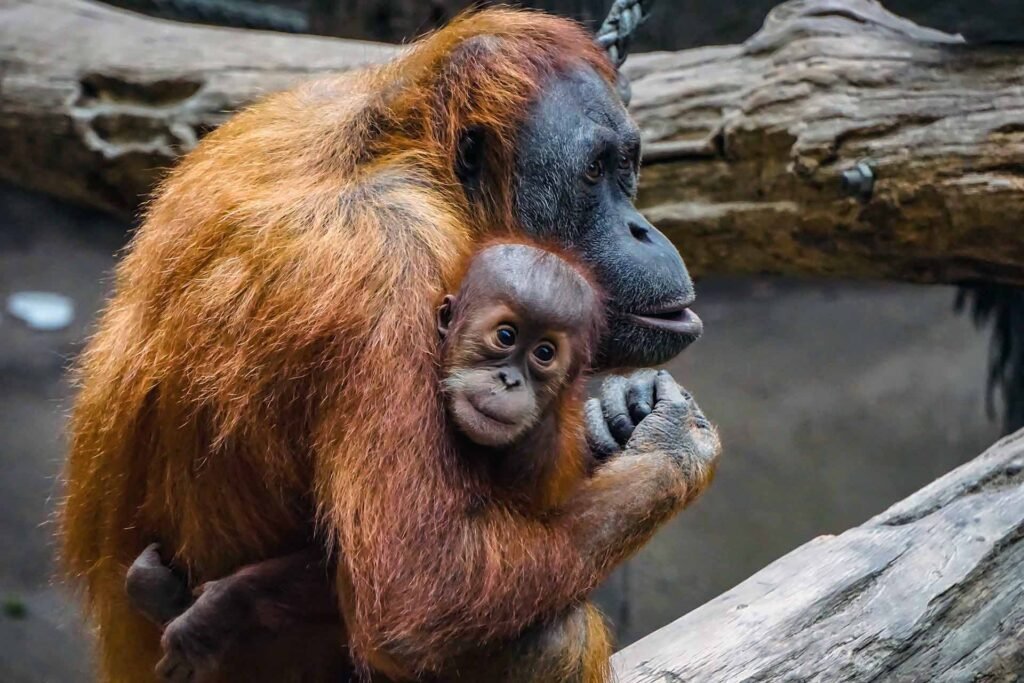
The relationship between a mother and her offspring is central to orangutan development.
A young infant remains physically close to its mother. As it grows, it begins exploring nearby branches while continuing to depend on her for movement, food knowledge, and protection.
This long learning period helps the young orangutan develop the skills needed to live independently.
What Young Orangutans Learn
A young orangutan needs to learn:
- Which foods are suitable
- Where food may be found
- How to move safely through the canopy
- How to process different foods
- How to build a nest
- How to respond to other orangutans
Many of these skills are learned by watching the mother.
An infant exploring nearby branches is not separated from its mother simply because there is a visible gap between them.
Give Mothers and Infants Extra Space
Never position yourself between a mother and her offspring.
Do not surround them, block their route, or call the infant to get its attention. Stay where your guide places the group and move back immediately when instructed.
A mother appearing calm does not mean visitors can move closer.
Learn more about responsible orangutan trekking and how visitor behaviour can affect wildlife.
Adult Males and Long Calls
Some mature male orangutans develop large cheek pads. These males are commonly described as flanged males.
Not every adult male looks the same. Male development varies, and visitors should avoid calling every large male an alpha.
What Is an Orangutan Long Call?
A long call is a powerful vocalisation made by mature males and some developing males.
It can carry through the rainforest over a considerable distance. Researchers associate long calls with communication toward females and other males.
Research has also examined how long calls may communicate a male’s future travel direction. You can read the study of orangutan long calls and movement.
Hearing a call does not mean that the male is beside the trail. Sound travels through the forest, and its direction may be difficult for an untrained listener to judge.
Stay quiet and let your guide explain what may be happening. Never imitate the call to attract a response.
Sounds That May Indicate Discomfort
Orangutans use different sounds in different situations.
One sound trekkers may hear is commonly called a kiss squeak. It is produced by drawing air through pursed lips and can be associated with anxiety or fear.
However, visitors should not use one sound to diagnose an animal’s mood with certainty. Context matters.
If an orangutan makes repeated sounds or appears uncomfortable, reduce movement and follow your guide. The group may need to increase its distance or leave the area.
Do Not Interpret Body Language by Yourself
A calm looking orangutan can still behave unpredictably.
One movement or facial expression may have different meanings depending on the individual and situation. Reading an article does not make it safe to approach or test an animal’s reaction.
Your guide may notice the animal’s position, nearby offspring, escape route, food, or other factors that are not obvious to visitors.
Follow the guide rather than relying on your own interpretation.
For practical preparation, read the orangutan trekking safety precautions.
Wild, Habituated, and Previously Rehabilitated Orangutans
Bukit Lawang has a history connected to orangutan rehabilitation.
As explained in the IUCN Great Ape Tourism Guidelines, orangutans in the area can have different histories and different levels of familiarity with people.
Some may be wild and avoid humans. Others may be more accustomed to seeing visitors or may have a connection to past rehabilitation.
You cannot reliably determine an individual’s history simply by looking at it.
Every orangutan should be treated as wildlife.
Familiar Does Not Mean Tame
An orangutan that approaches people is not asking to be touched.
Greater familiarity with humans can reduce an animal’s natural caution. It may also have learned to associate people, backpacks, or plastic bags with food.
Keep your bag closed and do not eat near an orangutan. Never give the animal food to make it move away.
Stay calm and let your guide manage the situation.
How Visitors Can Change Orangutan Behavior
The behaviour visitors hope to observe can be changed by the way those visitors act.
Feeding, calling, crowding, touching, or repeatedly approaching an orangutan can interrupt its natural activities.
Noise may cause an animal to move away. Food can encourage it to approach future groups instead of continuing its natural foraging behaviour.
Why Feeding Changes an Encounter
When an orangutan receives food from people, it may begin associating visitors with a possible reward.
A recent study of food solicitation behaviour in Bukit Lawang examined public videos involving two previously rehabilitated females. The findings suggested that illegal feeding may contribute to learned food related behaviour.
The study involved only two individuals and should not be used to describe every orangutan in Bukit Lawang. It still illustrates why individual history and human actions matter.
Feeding can also bring people and orangutans into close contact. This creates avoidable safety and health risks for both.
Close Photographs Can Give the Wrong Message
A photograph does not always show how the encounter happened.
Research examining visitor photographs from Bukit Lawang found examples of close proximity, feeding, and physical contact. The researchers highlighted the need for better compliance with the ten metre rule. The study is available through PubMed.
Do not move closer because another visitor does. A social media photograph is not evidence that an interaction was responsible.
The best wildlife image is one that does not require the animal to change its behaviour.
What to Do During an Orangutan Encounter
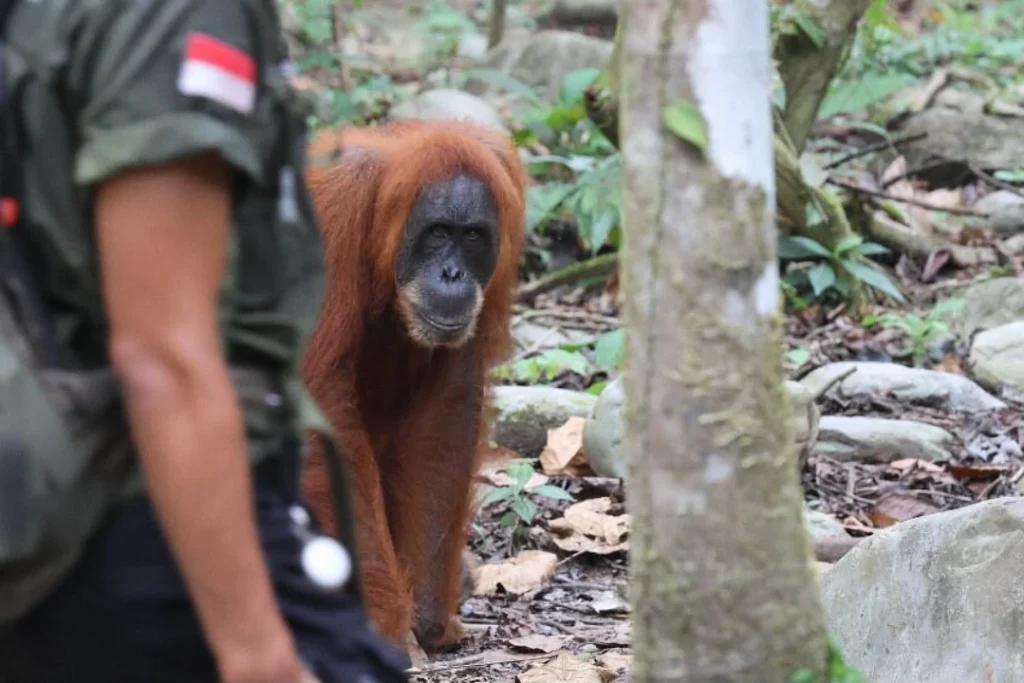
Your guide should position the group according to the animal’s location and movement.
During an encounter:
- Remain with the group
- Keep at least the required distance
- Stay quiet
- Keep food inside your bag
- Do not touch or feed the animal
- Do not call or chase it
- Do not block its route
- Avoid sudden movement
- Do not use flash photography
- Move away when instructed
Read the complete orangutan viewing rules before your trek.
If an Orangutan Moves Toward You
Stay calm and alert your guide if they have not already noticed.
Do not touch the animal, offer food, or open your backpack. Do not run unless the guide gives a specific instruction.
Leave a clear path and move back when directed. The guide should manage the group’s position.
Never stand between two orangutans, particularly between a mother and her infant.
Photograph Without Changing the Behaviour
Use camera zoom rather than walking closer.
Do not remove branches, shake vegetation, call the orangutan, or make noises to encourage it to look at you.
Leaves may cover part of the animal. Accepting that imperfect view is part of observing wildlife in a real rainforest.
Stop taking photographs when your guide asks the group to move.
Keep Your Expectations Realistic
No operator can guarantee that you will see a particular orangutan or behaviour.
An orangutan may be:
- Feeding high in the canopy
- Resting behind thick leaves
- Travelling away from the trail
- Caring for an infant
- Building a nest
- Calling from a distant part of the forest
- Absent from the route that day
A longer trek gives you more time in the rainforest, but it does not guarantee a sighting or a specific behaviour.
Guides may also point out old nests, fruiting trees, calls, and signs of animal movement. These details help explain how orangutans use the forest even when a clear sighting is not possible.
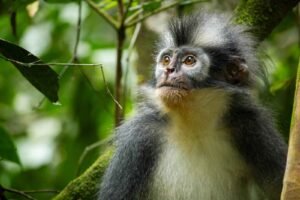
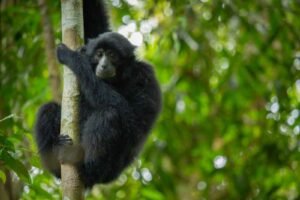
The rainforest is also home to other primates, birds, reptiles, insects, and plants. A meaningful trek should not depend on one animal appearing for visitors.
Choose Your Travel Dates Based on Trekking Conditions
Orangutans live in the rainforest throughout the year, but no particular month can guarantee a sighting or specific behaviour.
Your travel dates can still affect the practical trekking experience. Rain can make trails muddier, river conditions less predictable, and some routes more difficult. Even during relatively drier periods, tropical rain remains possible.
Read the guide to the best time to visit Bukit Lawang before choosing your dates. Select a period based on the trail conditions and visitor levels you prefer, not on a promise of seeing a particular orangutan.
Planning an Orangutan Trek as a Solo Traveller
Travelling alone does not mean entering the rainforest alone. Orangutan trekking should be completed with a local guide, and solo travellers should confirm the group arrangements before booking.
Depending on the selected date, you may be able to join an available group departure. Group availability cannot be guaranteed, so share your preferred trekking date before finalising transport and accommodation.
The guide to solo travel in Bukit Lawang explains transport, accommodation, group trekking, and practical preparation for travelling independently.
Frequently Asked Questions
Orangutans are relatively solitary, but they still maintain social relationships. Mothers travel with dependent offspring, and several orangutans may feed in the same area when food is abundant.
Fruit is an important part of their diet. They may also eat leaves, stems, bark, insects, and other naturally available foods.
They build leafy nests in trees. They often create a sleeping nest and may also build nests for resting during the day.
A long call is a loud vocalisation made by mature males and some developing males. It can communicate over a long distance to females and other males.
A kiss squeak can be associated with anxiety or fear. Visitors should not interpret the sound alone. Remain quiet and follow the guide.
Orangutans in the area can have different histories and levels of familiarity with people. Some may be wild, while others may have a connection to past rehabilitation. Every individual must be treated as wildlife.
Possible reasons include familiarity with visitors, individual history, curiosity, or an association between people and food. A visitor should not assume the reason or encourage the approach.
No. Stay calm, do not touch or feed the animal, and follow your guide’s instructions.
No. Orangutans move freely through the rainforest. Their location and behaviour cannot be scheduled or guaranteed.
Observe Orangutans With a Local Guide
Every orangutan encounter is different.
A local guide can help you notice feeding, movement, nests, calls, and other signs while keeping the group at a responsible distance.
Explore the available guided orangutan trekking in Bukit Lawang and choose a duration that suits your available time, fitness, and comfort with rainforest conditions.
A one day orangutan trek offers a rainforest experience without overnight camping.
A two day jungle trek provides more time in the forest and includes one night at a basic jungle camp.
Neither option can guarantee a sighting or particular behaviour. Choose based on the rainforest experience that suits you.