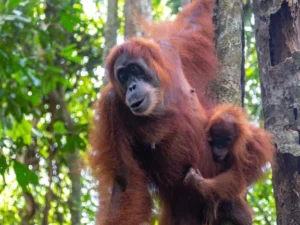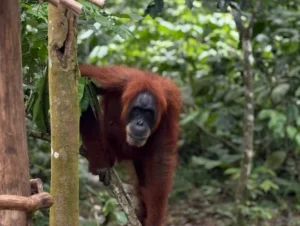
Most people arrive expecting a lucky glimpse. A flicker of orange fur through the trees, a branch trembling 30 meters up, and then nothing. What they don’t expect is the stillness that comes right before a wild sumatra orangutan holds its ground and looks back at you. Not performing. Not waiting for a banana. Just moving through the canopy on its own terms, in a forest that has belonged to its species longer than any of us can usefully imagine.
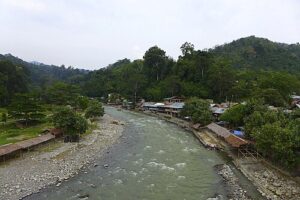
Bukit Lawang sits at the edge of that forest. It’s a small village in North Sumatra where the road ends and Gunung Leuser National Park begins, a UNESCO World Heritage Site covering over 2.6 million hectares of primary rainforest. The distance between your guesthouse and wild Sumatran orangutan habitat is measured in minutes, not hours.
This article covers everything you need to plan a responsible Bukit Lawang orangutan trek: where Pongo abelii actually lives, what trek options suit your schedule, how to get here from Medan, the best months to visit, and the ethical guidelines that make the encounter worth having. The team at Bukit Lawang Orangutan Tour serves as the local reference point for making it all work.
Why Bukit Lawang is the best base to spot the sumatra orangutan
The Sumatran orangutan (Pongo abelii) is critically endangered. With an estimated 11,694 individuals remaining across the species’ entire range, roughly 3,281 of those live within Gunung Leuser National Park, representing about 28% of the global population. This isn’t background context. It’s the reason Bukit Lawang matters: the forest here is one of the last places on earth where you can walk into wild Sumatran orangutan habitat without a flight to a remote research station.
Orangutans are arboreal. They spend most of their lives in the forest canopy, building a new nest each night and covering significant distances in search of fruit. Spotting one requires patience, a quiet group, and a guide who reads the forest well. Bukit Lawang’s direct access to primary rainforest is what separates it from other Sumatran locations where access is more restricted, more commercialized, or limited to rehabilitation centers where animals are managed rather than wild.
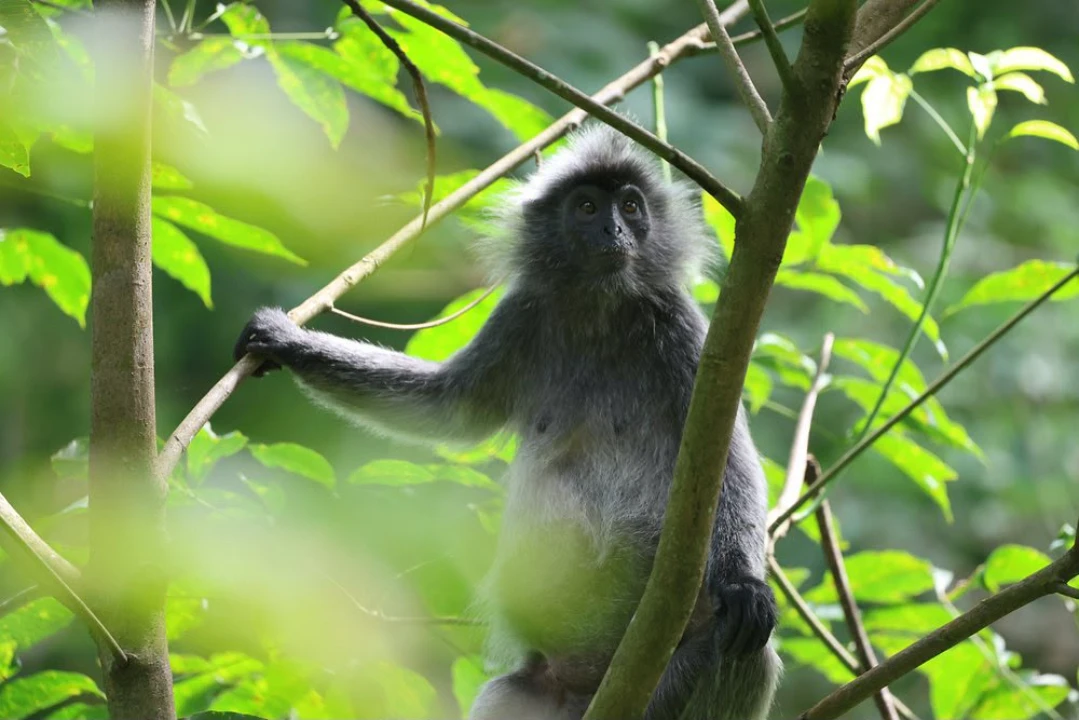
A real sighting looks like this: movement in the upper canopy, branches bending in a way that doesn’t match the wind, and then, if you stay quiet, a large amber shape resolving into something unmistakably alive and deliberate. There’s no guarantee. The forest also holds white handed gibbons, Thomas leaf monkeys, wreathed hornbills, and sun bears. Any trek, regardless of what you find in the canopy, is worthwhile on its own terms.
Trek lengths here match your schedule, not the other way around
A range of Bukit Lawang orangutan trek durations means you’re not forced into a one-size program. Each option places you inside genuine Leuser National Park orangutan habitat, not a boardwalk loop.
3 hour introductory walk
This costs approximately €55 per person. It takes you into the buffer zone of Gunung Leuser National Park, not just a village footpath, and suits travelers with tight itineraries, families with young children, or first-timers who want to test the terrain before committing to more.
Full day trek
Running around €70, this covers 6 to 8 hours of forest, usually with lunch included and a river tubing return. It’s the right call if you want a meaningful day without an overnight commitment.
2 day, 1 night and 3 day, 2 night options
The 2 day, 1 night option at approximately €100 to €120 per person is where most visitors find the experience tips into something genuinely memorable. You sleep in the jungle, move farther from the village edge, and spend enough time in the canopy’s shadows to encounter wildlife on its schedule rather than yours. The 3 day, 2 night trek runs approximately €145 to €170 and goes further into primary forest. For experienced trekkers, 4 to 7 day expeditions reach more remote routes toward Kuta Cane, with prices ranging from €250 to €700 depending on route and inclusions.
Most packages include the guide, national park permits, meals on full day and longer treks, camping equipment, and a river return. Confirm these details before booking, as individual quotes vary between operators.
On the practical side, short treks require basic walking fitness. Multi-day treks involve river crossings, steep muddy terrain, and camping in humid heat, so reasonable cardiovascular endurance matters. Bring trail shoes or boots, lightweight long sleeves, insect repellent, a rain layer, and a dry bag for electronics. HPI-certified local guides (HPI is Indonesia’s professional guide accreditation body) set the pace and adjust routes based on group ability, so you’re never locked into a program that doesn’t fit your group.
Getting from Medan to Bukit Lawang is straightforward if you plan it once
From Medan city center, Bukit Lawang is roughly 3 to 4 hours by road. From Kualanamu International Airport (KNO), allow 4 to 5 hours. Your main transport options break down clearly:
- Public bus via Binjai:approximately IDR 60,000 to 100,000 per person. Cheapest option, but slow, expect at least one transfer.
- Shared tourist shuttle:IDR 150,000 to 210,000 per person, 3 to 4 hours. Best balance of cost and comfort for solo travelers.
- Private car from Medan or KNO:IDR 700,000 to 800,000 per vehicle for up to four passengers, 3 to 4 hours. Most practical for small groups traveling together.
- Private minivan:around IDR 1,500,000 per vehicle for groups of up to ten people.
The practical call: use a shared shuttle if you’re traveling solo, or split a private car between two to four people. Before you confirm anything, check whether the quoted price includes airport pickup, tolls, luggage, and drop-off at your accommodation rather than just at the village entrance.
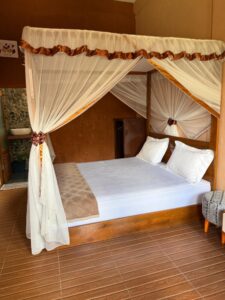
Bukit Lawang Orangutan Tour offers on site accommodation with both fan and air conditioned rooms, which removes the need to coordinate lodging separately. Arrival logistics are handled via WhatsApp. Message the team with your arrival time and they’ll take it from there, keeping the whole process simple and contained to one conversation.
When to visit Bukit Lawang for sumatra orangutan sightings
There’s a meaningful difference between visiting a rehabilitation center and trekking in Gunung Leuser. In a rehabilitation setting, animals are fed, managed, and habituated to human presence in ways that shape their behavior. In Gunung Leuser, the orangutans are semi-wild or fully wild. Guides do not feed them. Their movements are not curated. You are watching an animal make its own decisions in its own habitat. That unpredictability is not a flaw, it is the encounter itself.
For the best chances of a sumatra orangutan sighting, visit between June and August, when drier trails make movement easier and wildlife is active across a broader range of the forest. April to May and September to October are solid alternatives with fewer visitors and occasional fruiting periods that concentrate orangutans near productive trees. Start your trek between 7:00 and 8:00 a.m., when Sumatran orangutans and other species are most active before midday heat and afternoon rain slow everything down. Multi-day treks consistently outperform short walks in sighting likelihood, simply because of time spent inside the forest.
Responsible viewing is built into how ethical trekking works here
The guidelines are not complicated, and they’re not optional. Keep at least 10 meters from any orangutan at all times; if one approaches you, back away slowly. Never offer food, display food near animals, or leave waste on the trail. No flash photography. Do not imitate orangutan calls or make sounds intended to attract an animal. Limit your observation time to 15 to 30 minutes, and leave sooner if the animal shows any sign of stress. Travel in small groups and follow your guide’s instructions without exception.
These aren’t restrictions on the experience. They are the conditions that make a genuine encounter possible. An animal that has been fed or habituated to human approach behaves differently, and not in ways that benefit the animal or the visitor who came after you.
Feeding creates dependency and disrupts natural foraging behavior. It can also introduce human pathogens to a species with no immunity to many common human illnesses. Beyond individual animals, unethical encounters degrade the experience for future visitors and risk trail closures or permit restrictions that affect the entire local community. Responsible viewing is not a compromise. It’s the reason the encounter is worth having in the first place.
How Bukit Lawang Orangutan Tour puts the right trek in place
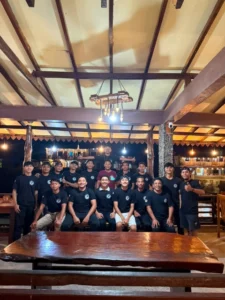
Bukit Lawang Orangutan Tour is a local guided trekking company based in Bukit Lawang, North Sumatra, operating as part of Explore Sumatra Wonders. Their guides hold HPI certification, which sets professional standards in guiding technique, wildlife ethics, and safety protocol. In practical terms, it means you’re not improvising your way into the forest with someone who learned the routes last season.
The company offers packages from 3 hour introductory walks through to 5 day wilderness expeditions, covering the full range of Leuser National Park orangutan terrain. All options include a guide and national park permits; full-day and longer treks include meals, and multi-day packages include camping equipment. Accommodation is available on-site in fan and air-conditioned rooms, keeping the logistics of your visit contained to one place rather than scattered across multiple bookings and contacts.
Booking is direct: reach out via WhatsApp, describe your schedule and group size, and the team will help you choose the right duration. From that first message through to the last day on the trail, the same local team is your point of contact. No intermediary, no platform fee, no automated confirmation email from someone who’s never set foot in the forest.
This is the kind of operator that doesn’t oversell the experience. The forest handles that part on its own.
One forest, the right guide, and a visitor prepared to observe
Bukit Lawang works for a clear set of reasons. It sits directly on the edge of wild Sumatran orangutan habitat inside Gunung Leuser National Park. Trek options range from 3 hours to 5 days, fitting any schedule. Transport from Medan is practical and well-documented. The wildlife encounters here are genuine rather than staged. And the ethical trekking culture protects both the animals and the quality of the visit itself.
Bukit Lawang Orangutan Tour is the practical path to all of the above. No pressure, no overclaiming, no promises about what the forest will or won’t show you on any given morning. That honesty is, in itself, a good sign.
The sumatra orangutan doesn’t need a stage. It needs space, a knowledgeable guide beside you, and a visitor who came prepared to observe rather than perform. Reach out to the team via WhatsApp, pick a duration that fits your schedule, and start there.