Sumatran and Bornean orangutans are separate species living on different islands.
The Sumatran orangutan is known scientifically as Pongo abelii and lives in northern Sumatra. The Bornean orangutan, Pongo pygmaeus, lives in parts of Indonesian and Malaysian Borneo.
They have some visible differences in their fur, faces and body shape. Researchers have also observed different patterns in how they use the forest and interact with other orangutans.
However, these are general patterns. Individual orangutans vary, and appearance alone is not always enough to identify a species with certainty.
For travellers, the biggest practical difference is often not the animal’s appearance. It is how you explore its habitat. Sumatra is known for walking based jungle trekking, while experiences in Borneo vary between forest walks, river journeys and rehabilitation centre visits.
Sumatran and Bornean Orangutans at a Glance
| Feature | Sumatran orangutan | Bornean orangutan |
|---|---|---|
| Scientific name | Pongo abelii | Pongo pygmaeus |
| Natural range | Northern Sumatra | Parts of Indonesian and Malaysian Borneo |
| General appearance | Often slimmer with longer, lighter hair | Often more heavily built with darker hair |
| Facial hair | Longer facial hair is common | Facial hair is often shorter |
| Adult male features | Flanges may appear narrower | Flanges may appear broader and more circular |
| Forest movement | Tends to spend more time in the canopy | More frequently recorded on the ground |
| Social behaviour | Some populations show greater social tolerance | Often described as more solitary |
| Common visitor experience | Rainforest trekking on foot | Varies between forest walks, boats and rehabilitation centres |
These characteristics can help explain broad differences, but they should not be treated as strict identification rules.
Are They Different Species?
Yes. Sumatran and Bornean orangutans are recognised as separate species.
The Sumatran orangutan is Pongo abelii. The Bornean orangutan is Pongo pygmaeus.
They were once treated as members of the same species. Genetic and physical research later supported their classification as separate species.
The Orangutan SSP taxonomy guide explains that this classification is based on genetic and morphological evidence, not simply on visible differences such as hair colour.
What About the Tapanuli Orangutan?
Sumatran and Bornean orangutans are not the only orangutan species.
The third recognised species is the Tapanuli orangutan, Pongo tapanuliensis. It lives in a limited area of Sumatra, south of the natural range of the Sumatran orangutan.
The Sumatran Orangutan Society provides a useful introduction to all three recognised species.
Travellers trekking from Bukit Lawang enter the habitat of Sumatran orangutans. Tapanuli orangutans do not live in the Bukit Lawang area.
How Their Appearance Can Differ
There are visible differences between Sumatran and Bornean orangutans, especially when comparing adult males.
However, age, sex, lighting and individual variation can make identification more difficult than it appears in photographs.
Fur, Face and Facial Hair
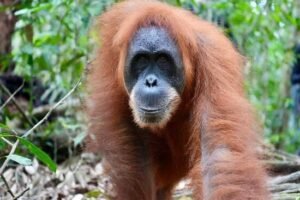
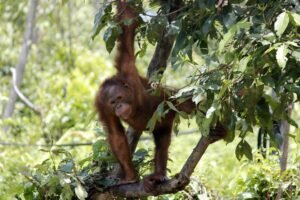
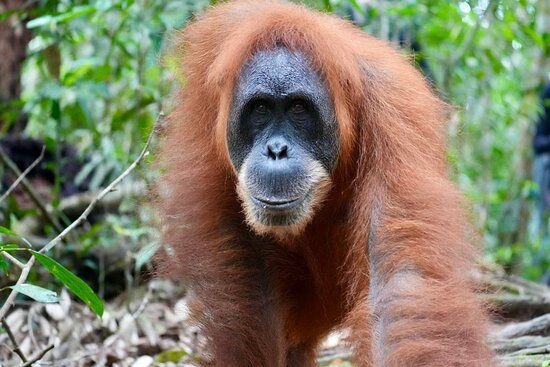
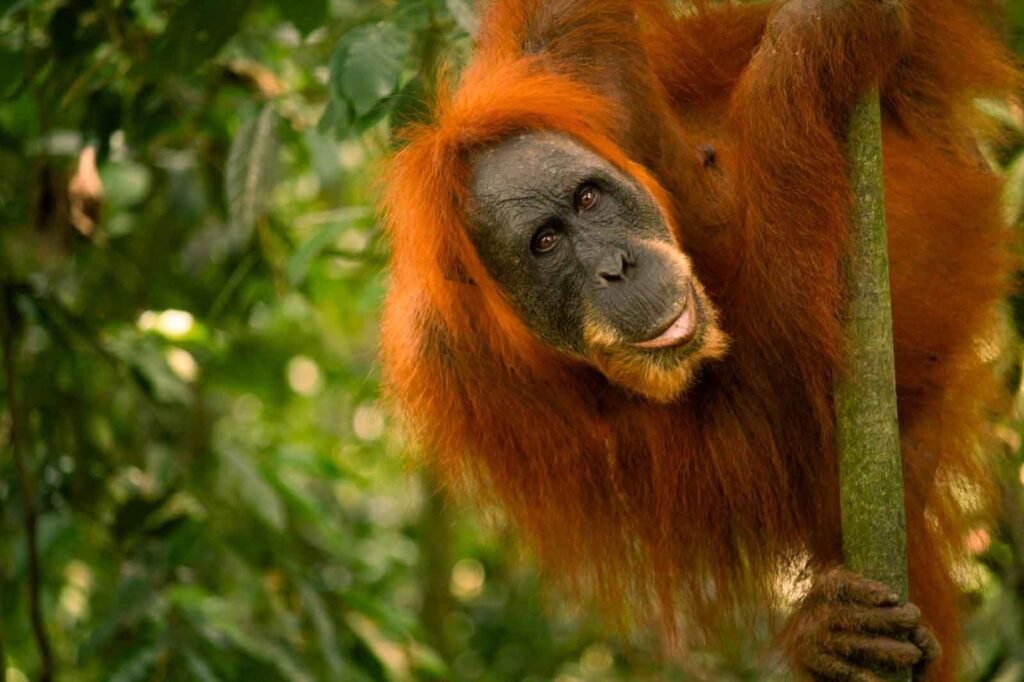
Sumatran orangutans generally have longer and lighter coloured hair. Their faces often appear longer and narrower, and both males and females may develop noticeable facial hair as they age.
Bornean orangutans often have darker hair and a more heavily built appearance. Their faces may look broader and rounder.
These are tendencies rather than fixed rules. A single orangutan may not display every characteristic normally associated with its species.
Adult Males and Cheek Pads
Mature male orangutans can develop large cheek pads called flanges. They also develop a throat sac that helps carry their long calls through the forest.
Adult Bornean males are often shown with broad, circular flanges and a prominent throat sac. Adult Sumatran males may have narrower flanges surrounded by longer facial hair.
Not every mature male has visible flanges. Orangutans can develop as either flanged or unflanged adult males, and both forms can reproduce.
The San Diego Zoo Wildlife Alliance orangutan guide provides photographs and explanations of these physical characteristics.
Why Appearance Alone Is Not Definitive
Hair colour or face shape can provide a clue, but it does not offer certain identification in every case.
The Smithsonian National Zoo notes that Sumatran orangutans are generally lighter and have longer hair, but reliable scientific identification goes beyond appearance alone.
For a traveller, location provides useful context. An orangutan living around Bukit Lawang is within the natural range of the Sumatran orangutan. An orangutan living in Borneo belongs to the Bornean species.
Where Do They Live?
The two species are separated geographically.
This is one of the clearest differences for travellers because seeing each species requires visiting a different island.
The Sumatran Orangutan Range
Sumatran orangutans live in northern Sumatra, Indonesia.
Their remaining habitat includes rainforest within the wider Leuser landscape. Bukit Lawang is one of the access points used by travellers joining guided rainforest treks in this region.
Bukit Lawang is not the only place associated with Sumatran orangutans. It is popular because travellers can combine a stay in the village with guided walking inside the rainforest.
The Bornean Orangutan Range
Bornean orangutans live in parts of Indonesian and Malaysian Borneo.
Borneo is a very large island, so there is no single “Borneo orangutan experience”. The type of trip depends on the destination.
Some areas offer forest walks. Others use boats for wildlife observation. Rehabilitation centres also provide a different experience from searching for free ranging wildlife in a large natural habitat.
Travellers should compare individual destinations rather than assume that every orangutan trip in Borneo follows the same format.
Do They Behave Differently?
Researchers have observed behavioural differences between populations in Sumatra and Borneo.
These differences may be influenced by habitat, food availability, population density and the presence of ground predators. They should be described as tendencies, not rules that apply to every individual.
Life in the Canopy and on the Ground
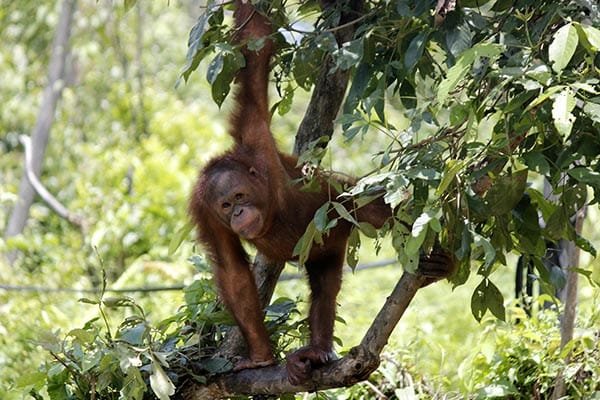
Sumatran orangutans tend to spend more time in the trees.
One possible influence is the presence of ground predators such as Sumatran tigers. Staying in the canopy may reduce some of the risks associated with travelling on the forest floor.
Bornean orangutans have been recorded using the ground more frequently. This does not mean they mainly live on the ground. Both species are highly adapted to life in trees.
An orangutan’s movement can also depend on its age, sex, surroundings and the availability of suitable trees.
Social and Feeding Patterns
Orangutans are often described as solitary, but that description is incomplete.
Mothers spend many years with their offspring. Other orangutans may also tolerate one another when food is available in the same area.
Some Sumatran populations have shown greater social tolerance than populations studied in Borneo. However, the Orangutan SSP notes that evidence for broad species level behavioural differences remains limited. Local population density and food availability may also explain some of the patterns.
Travellers should therefore avoid expecting every Sumatran orangutan to behave in one particular way.
What These Differences Mean for Travellers
Choosing between Sumatra and Borneo should not be based only on which species has lighter hair or larger cheek pads.
The more useful question is how you want to experience the rainforest.
Consider:
- How much walking you want to do
- Your comfort with humid and uneven jungle trails
- Whether you prefer walking, river travel or a rehabilitation centre visit
- How much time you have
- The wildlife viewing rules followed by the operator
- The type of accommodation and transport you prefer
Neither island is automatically right for every traveller.
Choose Sumatra If You Want a Walking Based Jungle Experience
Sumatra may suit you if hiking through the rainforest is an important part of the experience.
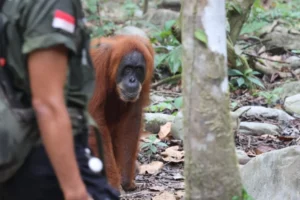
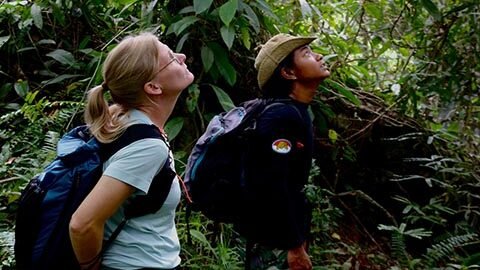
In Bukit Lawang, visitors enter the forest with a local guide and look for wildlife while moving along jungle trails. The walk itself is part of the experience, not simply transportation to a fixed viewing point.
Conditions can be humid, muddy and slippery. Your fitness, preparation and choice of trek should therefore matter as much as your interest in orangutans.
You can explore the available Sumatran orangutan trekking options in Bukit Lawang before deciding which experience suits you.
Consider Borneo If You Prefer Another Viewing Style
Borneo may suit travellers who prefer a different type of wildlife journey.
Depending on the destination, an orangutan trip may involve river travel, shorter forest walks, lodge based activities or a visit to a rehabilitation centre.
These experiences are not interchangeable. Seeing an orangutan near a rehabilitation facility is different from searching for free ranging wildlife during a rainforest journey.
Before choosing, check exactly where the activity takes place, how wildlife is observed and how much physical activity is involved.
Seeing Sumatran Orangutans Near Bukit Lawang
Guided treks from Bukit Lawang take travellers into rainforest habitat associated with the Sumatran orangutan.
A guide can look for movement, nests, feeding signs and sounds in the forest. Guides can also help visitors understand what an orangutan is doing without moving too close.
No guide can control where an orangutan travels. The number of animals seen, their distance from the trail and their behaviour will be different on every trek.
Sightings should never be guaranteed.
A short trek may suit someone with limited time. A longer experience provides more time inside the rainforest, but it still cannot guarantee a particular wildlife encounter.
Travellers interested in spending a night in the forest can review the two day Bukit Lawang jungle trek. Check the current package page before making plans, as conditions and arrangements may change.
Observe Both Species Responsibly
The same basic principles apply whether you visit Sumatra or Borneo.
Do not feed, touch, chase or call orangutans. Do not block an animal’s path to get a photograph. Keep food secure and follow the guide’s instructions.
A calm orangutan is still a wild animal. An animal that is familiar with people should not be treated as tame.
The quality of an encounter should not be measured by how close you can stand. A responsible experience allows the animal to choose whether it stays, moves away, feeds or rests.
Read our guide to ethical orangutan trekking in Bukit Lawang before entering the rainforest.
Which Destination Is Right for You?
Choose based on your travel style rather than trying to decide which orangutan species is better.
Sumatra may be a good match if you want an active, walking based rainforest experience. Bukit Lawang also works well for travellers who are already planning a wider journey through North Sumatra.
A destination in Borneo may be more suitable if you prefer river based wildlife viewing, a rehabilitation centre visit or a lodge based itinerary. The experience will depend on the specific region you choose.
Whichever island you visit, research the operator carefully. Look for clear wildlife rules, honest information about sightings and respect for the animal’s space.
Frequently Asked Questions
Yes. The Sumatran orangutan is Pongo abelii, while the Bornean orangutan is Pongo pygmaeus.
They are genetically and physically distinct species.
Sometimes you can notice general differences in fur, facial hair and body shape.
However, individual variation means that appearance alone does not always provide certain identification. The location where the orangutan lives offers important context.
There is too much overlap and individual variation to use size as a simple identification rule.
Sex and age also make a major difference. An adult male will normally look much larger than a female or juvenile of the same species.
Sumatran orangutans tend to remain in the canopy more consistently.
Researchers connect this pattern to several ecological factors, including forest structure and the presence of ground predators. It should still be treated as a general tendency rather than a rule for every animal.
Yes. The Tapanuli orangutan, Pongo tapanuliensis, is the third recognised species.
It lives in a different part of Sumatra and is not the species encountered during trekking from Bukit Lawang.
Bukit Lawang is associated with the Sumatran orangutan, Pongo abelii.
Travellers join guided treks from the village to explore rainforest habitat where these orangutans and other wildlife move freely.
No.
Orangutans move freely through the rainforest. Guides can search for signs and choose suitable trails, but they cannot determine where wildlife will be.
A responsible operator should be honest about this uncertainty. You can read more about responsible orangutan trekking before choosing an experience.
Meet Sumatran Orangutans on Their Terms
Sumatran and Bornean orangutans are different species, but neither should be treated as a better version of the other.
Each belongs to a distinct rainforest environment. The right destination depends on how you want to travel, how active you want to be and how the operator approaches wildlife observation.
If a walking based rainforest experience suits you, explore our guided Sumatran orangutan trekking options.
You can also check the best time to visit Bukit Lawang before choosing your travel dates.
Wildlife encounters cannot be promised, but a well prepared and responsible trek can help you experience the rainforest without forcing the animals to change their natural behaviour.