
If you’re planning jungle trekking in Bukit Lawang, this is the honest guide you actually need. The internet is full of conflicting advice, outdated logistics, and trip reports written by people who visited once and positioned themselves as authorities. The forest, for its part, demands less preparation than the online discourse suggests, but it does require clarity about what you’re signing up for.
By the end of this guide, you’ll know which trek length fits your schedule and fitness, what wildlife you’ll realistically encounter, how to identify an ethical guide, and what to pack. The team at Bukit Lawang Orangutan Tour works within Gunung Leuser National Park daily, and that practical context shapes everything covered here.
Jungle trekking Bukit Lawang: which trek length makes sense for you
Short treks: half day to 1 full day
A half day or full day route is a completely valid choice, not a consolation prize. These options suit families with young children, travelers with tight schedules, and first-timers who want a genuine taste of the rainforest without committing to overnight camping. Short daytime walks along active wildlife corridors still offer a realistic chance of orangutan sightings near the forest edge, where semi-habituated individuals are more commonly spotted. Some Bukit Lawang operators offer half-day options specifically designed to reach those areas efficiently.
Overnight to 3 day treks: the sweet spot for most travelers
The 2 day/1 night and 3 day/2 night formats are where most independent travelers land on the 2 day vs 3 day Bukit Lawang trek question. The rhythm is consistent across both: early start around 8 or 9 a.m., six to eight hours of trekking, a riverside camp, jungle meals cooked over a fire, and a tube-raft return on the final day along the Bohorok River. The 2 day format already gives you a strong chance of orangutan encounters, local operator reports and guide experience put that figure at roughly 85, 90% during dry season. Longer doesn’t always mean more sightings, and it’s worth being honest about that before you commit.
4 to 5 days: for travelers who want to go deeper
The extra days give you quieter trails, more remote campsites, and extended time tracking wildlife deeper in the park. You’ll encounter genuinely wild orangutans rather than the semi-habituated individuals common near the park entrance. The trade-off is real: terrain is steep, muddy, and hot, and the physical demands are significant. This format suits active travelers with multi-day hiking experience, not casual walkers looking to stretch a 2 day trip.
Here’s a realistic cost breakdown per person, based on typical operator pricing in the region (rates are subject to change; confirm directly with your operator):
| Duration | Approximate price/person | Typically included |
| 2 days / 1 night | €120 | Guide, park permit, meals, camping, tubing |
| 3 days / 2 nights | €170 | Same inclusions |
| 4 days / 3 nights | €250 | Same inclusions |
| 5 days / 4 nights | €320 | Same inclusions |
Transport from Medan and village accommodation before or after the trek are usually priced separately. Budget for both when you plan.
Jungle trekking Bukit Lawang: wildlife you’ll realistically encounter
Orangutan sightings: the honest odds
During dry season, local guides and operator reports consistently place orangutan sighting chances at roughly 85, 90%. Wet season drops that figure closer to 60%. Many encounters happen on day one, near Bukit Lawang, where semi-habituated individuals accustomed to human presence are active. Some trekkers on 4 day programs see their only orangutan in the first few hours. Longer treks provide more cumulative opportunity, but not proportionally better results.
Any operator who promises guaranteed close encounters, selfies, or physical contact is a red flag. The animals are wild. Sightings depend on season, weather, animal movements, and luck. A good guide acknowledges this upfront.
Beyond orangutans: what else lives in the forest
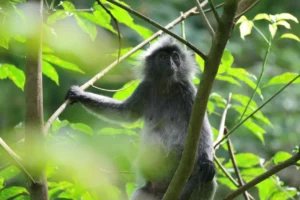
The rest of the wildlife is extraordinary in its own right. Thomas leaf monkeys move through the canopy in loud, acrobatic groups. White-handed gibbons fill the forest with calls you’ll hear long before you have any chance of spotting them. Long-tailed macaques are everywhere near the river. Great hornbills cut across clearings with a wingspan that stops conversation. Below the canopy, reptiles, insects, and medicinal plants form an entirely separate world worth paying attention to.
Knowledgeable guides interpret the forest ecology as you walk, turning every rest stop into something with context. The trek isn’t only about the orangutan you may or may not see. It’s about understanding what kind of place you’re standing in.
Ethics and conservation rules inside the national park
What Gunung Leuser National Park actually requires
Every trekker must enter with an official park permit and an authorized local guide. The permit costs approximately Rp150,000 per foreign visitor per trip, confirm the current rate with your operator or directly with the park, as fees can be updated. Legitimate operators include this in their pricing. Rules are firm: no feeding wildlife, no touching or baiting animals, no clearing vegetation for a better photo angle, no leaving food or waste in the forest.
What ethical behavior looks like on the trail
The practical application matters more than the rules list. If an orangutan approaches you, the correct response is to move away calmly while following your guide’s direction. The ethical standard is to let the animal determine the proximity. If a guide encourages you to move closer, extend your arm, or wait while a wild animal investigates your group at close range, that’s a problem worth addressing directly.
Bukit Lawang Orangutan Tour states a strict no contact policy on every trek, minimum safe distance, no baiting, no following animals that are trying to leave. Verify the written policy directly with the operator before booking, and apply the same check to any Bukit Lawang tour operator you consider. Ethical practice should be the baseline, not a premium feature.
How to find a guide who actually knows the forest
What HPI certification tells you and what it doesn’t
HPI (Himpunan Pramuwisata Indonesia) is Indonesia’s professional guide credential. Ask to see a current card before booking. Certification confirms professional training and provides a useful baseline, but it isn’t a wildlife-welfare guarantee on its own. What matters alongside it: explicit no-contact wildlife rules stated clearly before the trek, a reasonable guide-to-guest ratio, and a willingness to answer direct questions about on-trail practices without defensiveness.
Booking through Bukit Lawang Orangutan Tour
Bukit Lawang Orangutan Tour offers trekking packages from short daytime options up to 5 day Gunung Leuser trekking itineraries, all operating within the national park. Guides hold HPI certification and carry deep knowledge of the park’s trail system and wildlife behavior built over years of daily work in the forest. Every package is built around ethical viewing standards: no contact, appropriate distance, and leaving the forest as you found it.
Booking runs through WhatsApp, which is practical for independent travelers who aren’t using a third-party platform. Communication is direct rather than filtered through a booking layer. Reach out to confirm your dates, package, and logistics before you arrive, and use that conversation to verify credentials and facilities firsthand.
Staying in Bukit Lawang before and after the trek
Bukit Lawang Orangutan Tour has on site accommodation with both fan and air conditioned room options. Arriving the day before the trek is worth building in: it gives you time to rest after the journey from Medan, meet your guide, and confirm the plan for the next morning. A night in the village after returning from a multi-day trek is also worth considering, especially before a long drive back.
What to pack (and what to leave at the guesthouse)
What to bring into the forest
Pack light. Guides on overnight treks typically supply tents, sleeping mats, and camp cooking equipment, so personal gear stays manageable. The core list that actually works:
- Waterproof daypack with rain cover, 30, 40 liters
- Long-sleeved quick-dry shirts, long trousers, and long socks for sun, insects, and leeches
- Sturdy trekking shoes or boots with solid grip; expect mud and wet surfaces
- Lightweight rain poncho that covers your pack
- Insect repellent, high-SPF sunscreen, and a hat
- Refillable water bottle, headlamp with spare batteries, and small dry bag for electronics
- Personal first-aid kit, oral rehydration salts, and any prescription medication
- Minimal cash in Indonesian rupiah for tips and incidentals
What to leave behind
Cotton clothing is a serious mistake in humid jungle heat. It absorbs moisture and stays wet, real discomfort over six to eight hours of hiking. Leave jeans, heavy towels, and anything you’d be genuinely upset to damage. If you’re staying at on-site accommodation before the trek, leave your main bag at the guesthouse and carry only what you need into the forest.
Getting to Bukit Lawang and when to go
Transport from Medan and Kualanamu Airport
Bukit Lawang is three to four hours from Medan city and four to five hours from Kualanamu International Airport (KNO). A private car is the most reliable option: approximately IDR 700,000 from Medan and IDR 800,000 from KNO. Public transport via Binjai is viable but slower and less predictable, with multiple connections and no fixed timetable. Leave in the morning and arrive in daylight.
For the return journey, pre book a private transfer if you’re catching a flight. Allow at least six to seven hours before a domestic departure, more for international. Missing a connection because of underestimating the drive is an avoidable problem.
Best and worst months for jungle trekking
Dry season runs roughly May through September, with June to August offering the most reliable trail conditions and higher orangutan sighting rates. May and September give a good balance of weather and fewer crowds than the peak months. October typically marks the start of increased rainfall, and November through January brings heavier rain, muddy paths, and river levels that can affect the tube-raft return. Wet season trekking is still possible, but it demands more flexibility and tolerance for harder conditions. For families or first-time trekkers, the dry-season window is the straightforward choice.
The forest is more manageable than the planning phase makes it feel
Once you’ve matched the trek length to your time and fitness honestly rather than aspirationally, and confirmed a guide with the right credentials and clear wildlife ethics, most of the work is done. Converting that into action is straightforward: settle on the itinerary that fits your actual schedule, verify HPI certification and explicit no-contact wildlife rules, pack light, and arrive the day before your trek starts.
Gunung Leuser trekking earns its reputation not through marketing copy, but through what the forest actually delivers: a living, functioning rainforest recognized among the most biodiverse regions on Earth, experienced with a guide who knows every trail. That’s what makes it worth the journey.
If you’re ready to move from planning to booking, get in touch with the Bukit Lawang Orangutan Tour team on WhatsApp to confirm your dates and package. The process is direct, and the team will walk you through everything before you arrive. For any jungle trekking Bukit Lawang questions still on your list, a short conversation with the operator will sort your plan faster than another hour of forum browsing.