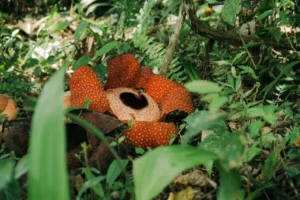
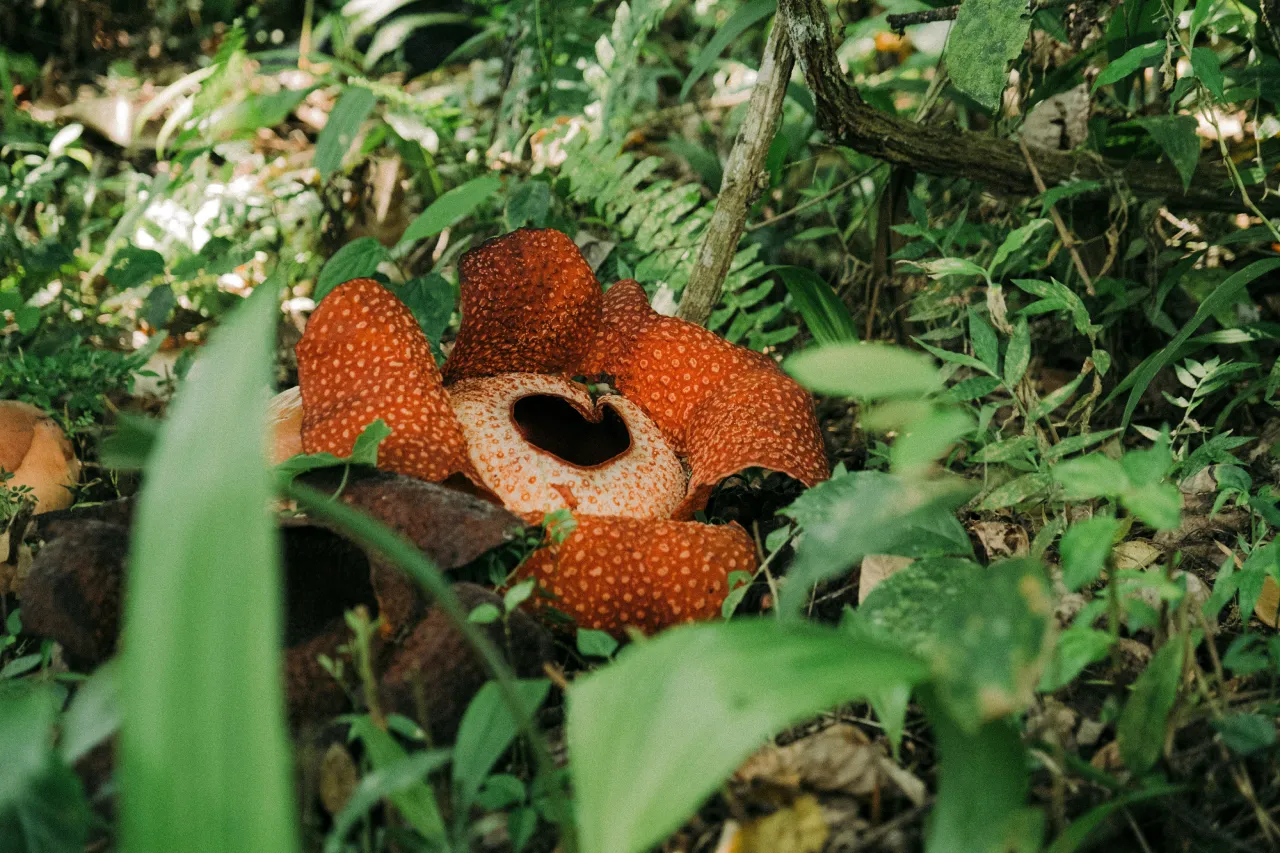
Yes, Rafflesia species have been documented in the wider rainforest around Bukit Lawang and Gunung Leuser.
However, an open flower is never guaranteed. Rafflesia spends most of its life hidden inside a host vine, and the visible flower remains open for only a short period.
The species also matters. A Rafflesia found near Bukit Lawang should not automatically be called Rafflesia arnoldii. Scientific records from this region include Rafflesia lawangensis and Rafflesia micropylora.
If seeing one is important to your trip, check recent bloom information with a knowledgeable local guide close to your travel date. Do not plan your entire visit around an unconfirmed flower.
Which Rafflesia Species Grow Near Bukit Lawang?
Sumatra is home to several Rafflesia species. They do not all have the same size, appearance or distribution.
Two species are particularly relevant to travellers staying near Bukit Lawang.
Rafflesia lawangensis
Rafflesia lawangensis has a direct connection to Bukit Lawang.
The species was described from the Bukit Lawang area and named after its type locality. It had previously been recorded as another Rafflesia species before researchers identified physical characteristics that made it distinct.
The original description was published in the Indonesian botanical journal Reinwardtia.
More recent research has also reported Rafflesia lawangensis from another location in the wider Gunung Leuser region. Its known distribution is therefore no longer limited to the original site, although it remains a highly restricted species.
A 2024 study assessed Rafflesia lawangensis as Critically Endangered. That makes careful management of its habitat especially important.
Rafflesia micropylora
Another species recorded in Gunung Leuser is Rafflesia micropylora.
A 2024 distribution study reported this species from several locations, including Batu Katak in North Sumatra.
Batu Katak is sometimes included in nature excursions from Bukit Lawang. Its presence in scientific records does not mean an open flower will be available when you visit.
The same study assessed Rafflesia micropylora as Endangered.
Why It May Not Be Rafflesia arnoldii
Rafflesia arnoldii is the best known Rafflesia species from Sumatra. It is famous for producing the world’s largest individual flower.
That does not make “Rafflesia arnoldii” a general name for every Rafflesia in Sumatra.
Rafflesia lawangensis is a separate species. Rafflesia micropylora is another separate species. Each has its own physical characteristics and recorded distribution.
If the species has not been confirmed, it is more accurate to call the plant “Rafflesia” rather than assume it is Rafflesia arnoldii.
Claims such as “the world’s largest flower near Bukit Lawang” should also be treated carefully. The record associated with Rafflesia arnoldii does not apply automatically to every member of the genus.
What Makes Rafflesia So Unusual?
Rafflesia does not look like a normal plant because most of it cannot be seen.
It is a holoparasite, which means it depends entirely on a host plant for water and nutrients.
A Plant Hidden Inside Its Host
Rafflesia lives inside vines belonging to the genus Tetrastigma.
It does not have conventional leaves, stems or roots. Its vegetative tissue develops inside the host, hidden from view.
A bud eventually emerges from the vine. If the bud develops successfully, it opens into the large flower seen in photographs.
Scientific research into Rafflesia biology shows why the plant is difficult to study and protect. Much of its life happens inside another plant, and not every infected vine produces a visible flower.
This hidden life also explains why finding Rafflesia is not as simple as walking to a permanent flower patch.
Why Does Rafflesia Smell?
An open Rafflesia may produce an odour associated with decaying organic material.
The smell helps attract flies involved in pollination. The insects visit the flower and may carry pollen to another bloom.
Rafflesia is not a carnivorous plant. It does not trap or eat the flies.
The strength of the smell can vary. A traveller should not expect every flower to produce the same odour at every stage of its bloom.
When Can Travellers See a Rafflesia Bloom?
There is no travel date that guarantees an open Rafflesia.
Weather and forest conditions may affect access, but a general rainy or dry season calendar cannot tell you exactly when an individual bud will open.
The most useful information comes from people who have recently checked known plants and developing buds.
There Is No Guaranteed Blooming Date
Rafflesia can remain hidden inside its host for a long time before a bud becomes visible.
Even a visible bud does not provide a guaranteed flowering date. Buds can develop slowly, and some may not reach full bloom.
This makes long term promises unreliable.
You can choose your travel period based on the conditions you prefer for rainforest walking. Our guide to the best time to visit Bukit Lawang can help with that decision.
However, a comfortable period for trekking is not automatically a Rafflesia blooming season.
The Open Flower Does Not Last Long
Research on Rafflesia species has recorded flowering periods lasting only several days.
One study of Rafflesia flowering stages recorded blooms lasting about five to eight days for the species it examined. The exact period can vary between species and individual flowers.
This short window means that bloom information becomes outdated quickly.
A flower reported as ready to open may still not be available when you arrive. A flower that has already opened may begin to darken and decay before your visit.
Where Might a Guided Rafflesia Search Take Place?
Bukit Lawang can serve as a base for exploring the surrounding area, but the flower may not be within walking distance of your accommodation.
The search location depends on recent reports, access, trail conditions and which species has been recorded in the area.
Bukit Lawang and the Wider Leuser Area
The name “Bukit Lawang Rafflesia” can refer to plants documented in the wider landscape rather than a flower growing inside the village.
Scientific records connect Rafflesia lawangensis with the Bukit Lawang area. Additional records have expanded its known distribution within North Sumatra.
Travellers should not expect a permanent viewing garden or a fixed flower beside a standard trail.
A qualified guide may need to confirm whether a recent bloom has been reported and whether the location can be visited responsibly.
If you are still arranging your journey, read how to get to Bukit Lawang before planning activities outside the village.
Batu Katak and Other Documented Areas
Batu Katak appears in scientific records as a location for Rafflesia micropylora.
Its documented presence means the surrounding habitat supports the species. It does not mean there is always an open flower.
The exact walking route may change according to the location of a bud or bloom. Rain, trail conditions and conservation concerns can also affect access.
Precise flower locations should be managed carefully. Visitors should follow local guidance rather than searching independently through sensitive vegetation.
A Rafflesia Search Is Not a Standard Orangutan Trek
A Rafflesia search and an orangutan trek are different activities.
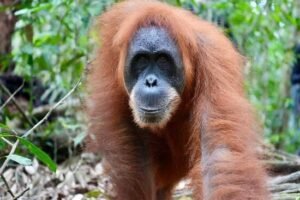
Orangutan trekking from Bukit Lawang focuses on walking through rainforest habitat while looking for free ranging wildlife. A Rafflesia visit depends on recent information about a specific bud or open flower.
Joining a standard orangutan trek does not mean you will see Rafflesia.
Likewise, visiting a Rafflesia location does not guarantee an orangutan encounter.
If your main interest is wildlife and rainforest walking, compare the available Sumatran orangutan trekking options in Bukit Lawang separately.
What a Responsible Rafflesia Visit Should Look Like
A large flower may look strong, but the plant and its habitat are sensitive.
The visible bloom is only one part of a relationship between Rafflesia and its host vine. Damage to the vine, nearby buds or surrounding vegetation can affect future flowers.
Follow Local Guidance Around the Flower
During a responsible visit:
- Do not touch the flower or its buds.
- Do not stand on or step across the host vine.
- Do not remove leaves or vegetation for a clearer photograph.
- Stay on the route chosen by the guide.
- Do not collect any part of the plant.
- Carry all rubbish out of the forest.
- Avoid sharing sensitive location details publicly.
A photograph should not require damaging the habitat.
If the safest viewing position is farther away than expected, accept the available view rather than moving closer.
Prepare for Changing Forest Conditions
A Rafflesia search may involve wet, muddy or uneven terrain.
Wear footwear with suitable grip and bring rain protection. Keep your phone and camera in waterproof protection.
Carry any personal medication you may need. Tell the guide about relevant health or mobility concerns before entering the forest.
Routes may need to change when rain or trail conditions create additional risks.
Our Bukit Lawang jungle trekking safety guide provides general preparation advice for natural rainforest conditions.
Rafflesia and Titan Arum Are Not the Same Plant
Rafflesia is often confused with titan arum because both can produce a strong smell and both are associated with Sumatra.
They are completely different plants.
Rafflesia is a parasitic plant that lives inside a Tetrastigma host. The visible structure is one individual flower.
Titan arum, Amorphophallus titanum, grows from an underground tuber. Its tall visible structure is an inflorescence, which is a group of many small flowers rather than one flower.
The Royal Botanic Gardens, Kew describes titan arum as producing the world’s largest unbranched inflorescence.
The common name “corpse flower” may be used for both plants because of their smell. Using their scientific names avoids confusion.
Seeing one does not mean you have seen the other.
What If No Rafflesia Is Blooming?
No bloom should be treated as a normal possibility, not as a failed promise.
A knowledgeable guide may still be able to explain the habitat, host vines and development of visible buds without disturbing them. The surrounding forest can also offer opportunities to learn about other plants and local ecology.
However, the experience should never be presented as though a closed bud is the same as seeing an open flower.
Keep an alternative plan for your time in Bukit Lawang. This might include village activities, river areas or a guided rainforest trek.
If you choose an orangutan trek, treat it as a separate experience with its own purpose. Wildlife sightings are natural and cannot be guaranteed.
How to Plan Your Visit
Start by arranging your journey to Bukit Lawang and choosing flexible dates for local activities.
If you hope to see Rafflesia, ask a qualified local guide whether any buds or flowers have recently been reported. Check again close to your arrival because the situation can change quickly.
Useful questions include:
- Has an open flower been confirmed recently?
- Has the species been identified?
- Is the location currently accessible?
- Is a local guide required?
- What are the current trail conditions?
- What happens if the flower is no longer open?
Avoid any operator that promises an open flower far in advance without current evidence.
It is also sensible to keep a free period in your itinerary. A location may become unavailable because of weather, access or conservation concerns.
Frequently Asked Questions
Can You See Rafflesia in Bukit Lawang?
Rafflesia has been scientifically documented in the Bukit Lawang area and the wider Gunung Leuser region.
That does not mean an open flower is always available. Recent local information is needed before arranging a visit.
Which Rafflesia Species Is Found Near Bukit Lawang?
Rafflesia lawangensis was described from the Bukit Lawang area.
Rafflesia micropylora has been recorded from several locations in Gunung Leuser, including Batu Katak.
Is It Rafflesia arnoldii?
Not necessarily.
Sumatra has several Rafflesia species. A flower near Bukit Lawang should not automatically be labelled Rafflesia arnoldii.
Use the general name “Rafflesia” when the species has not been confirmed.
When Is the Best Time to See Rafflesia?
No month can guarantee a bloom.
Ask for recent information close to your travel date. A general weather season may help you choose preferred trekking conditions, but it cannot confirm that a flower will be open.
How Long Does a Rafflesia Flower Stay Open?
Research on some Rafflesia species has recorded open flowers lasting less than a week.
The exact period can vary by species and individual flower. Bloom information should therefore be checked as close as possible to the planned visit.
Is Rafflesia the Same as Titan Arum?
No.
Rafflesia produces an individual flower and lives as a parasite inside a host vine. Titan arum grows from a tuber and produces a tall inflorescence containing many small flowers.
Can I See Rafflesia During an Orangutan Trek?
It should not be expected.
A standard orangutan trek and a Rafflesia search have different purposes and may take place in different areas. Confirm each activity separately.
Can I Touch a Rafflesia Flower?
No.
Do not touch the flower, buds or host vine. Follow the guide’s route and keep a respectful distance from the plant.
Plan a Flexible Rainforest Experience
Rafflesia is part of what makes the forests of North Sumatra botanically remarkable, but it follows its own timetable.
Check recent bloom information, keep your itinerary flexible and be prepared for the possibility that no flower will be open.
If your main goal is to experience the rainforest rather than depend on one rare bloom, explore our guided Bukit Lawang jungle trekking options.
The trek should be chosen for the rainforest experience itself. Neither an orangutan encounter nor a Rafflesia bloom should be promised.